Home service marketing has a job most other marketing does not. It has to convince a stranger to let your crew into their house. A homeowner calling about a leaking water heater or a dead AC unit is not comparing feature lists. They are deciding who feels safe, competent and available right now. Every channel in this guide either builds that feeling ahead of time or captures it at the moment of need.
CraigAds has worked with more than 2,000 local businesses, and the pattern holds across plumbing, HVAC, roofing, cleaning and landscaping. The companies that grow treat marketing as one connected system. The ones that stall buy tactics one at a time and never learn which one paid off. This guide lays out the whole system, from the funnel behind it to a 90-day plan.
In this guide
- Why Home Service Marketing Runs on Trust
- Brand, Engage, Act: The Full-Funnel Model
- The 7 Channels That Generate Home Service Leads
- Tracking Leads From First Call to Paid Job
- Setting a Marketing Budget for a Home Service Business
- A 90-Day Home Service Marketing Plan
- Your Home Service Marketing Checklist
Why Home Service Marketing Runs on Trust
Most purchases end at a checkout page. A home service purchase ends with a technician standing in someone’s kitchen. Price matters, but it rarely decides the call on its own. Homeowners want proof that you show up on time, do clean work and treat their home with respect.
Craig’s background is in applied psychology, and it shapes how we build every campaign. People rarely decide based on information alone. They decide based on how a business makes them feel, then use the facts to justify the choice. Reviews, real job photos, a fast reply and a consistent brand all lower the perceived risk of saying yes. Good home service marketing stacks those signals, so the decision feels easy before the phone ever rings.
Brand, Engage, Act: The Full-Funnel Model
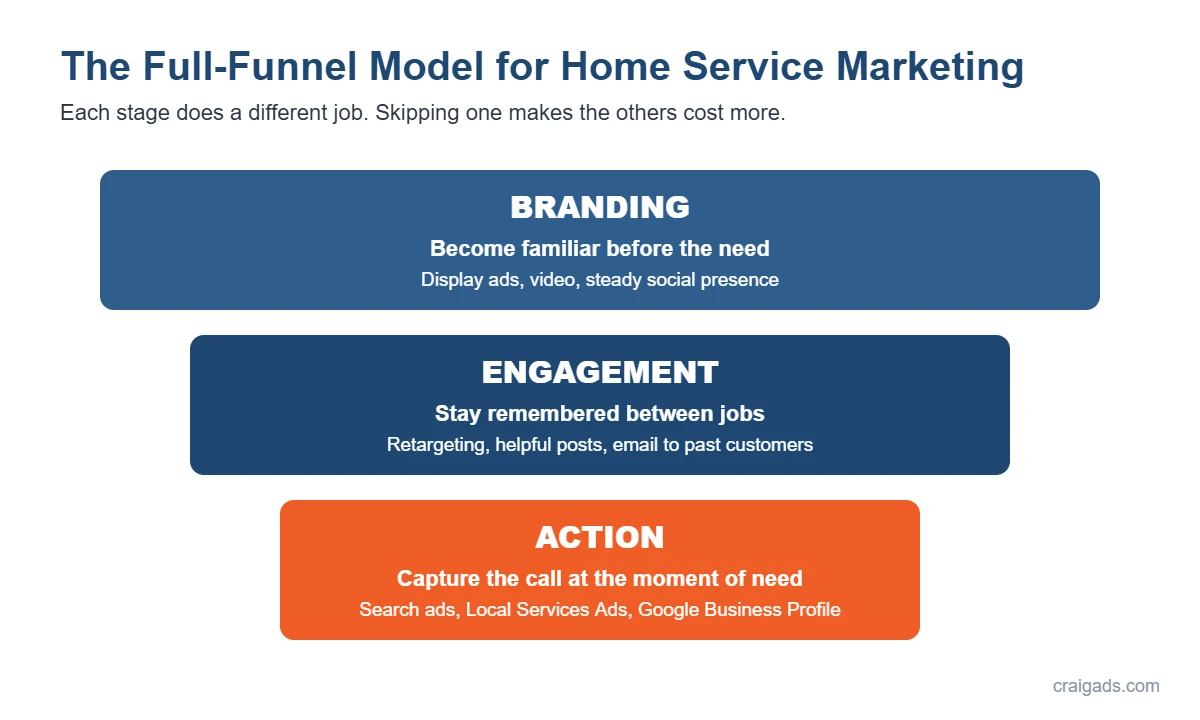
We organize every plan around three stages. Each one does a different job, and skipping any of them makes the others more expensive.
- Branding puts your name in front of homeowners before they need you. Display ads, video and a steady social presence make your company familiar, so your listing looks known when the need arrives.
- Engagement keeps people interested between jobs. Retargeting, helpful posts and email remind past visitors and past customers that you exist.
- Action captures demand at the moment of need. Search ads, Local Services Ads and your Google Business Profile turn a burst pipe into a booked call.
Most home service marketing budgets go almost entirely to Action. That works until the cost per lead climbs, which it eventually does in any competitive market. Branding and Engagement are what make Action cheaper over time. Our full-funnel marketing solutions page explains how each stage fits together.
The 7 Channels That Generate Home Service Leads
No home service marketing plan needs all seven channels on day one. The right mix depends on your trade, your service area and how quickly you need the phone to ring. Start with the first three, then add the rest as tracking shows what works. For a trade-specific version of this list, see our plumber marketing guide.
1. Google Business Profile
Your Google Business Profile is often the first thing a homeowner sees, even before your website. Google says local results are based mainly on relevance, distance and prominence. You cannot move your shop closer to every customer, but you can control relevance and prominence. Choose accurate categories, list every service, add real job photos and keep your hours current. Post updates regularly, so the profile looks active. Our Google Business Profile optimization checklist walks through every field.
2. Local SEO and Your Website
Organic rankings are the slow, compounding side of home service marketing. They take longer to earn than ads, but they keep producing calls after the work is done. The foundation is one strong page per core service, with clear headings, real photos and an obvious way to call or book. Add pages for the towns you serve only when you can say something specific about each one. Thin city pages with only the name swapped tend to get ignored. Our post on local SEO strategies for home service businesses covers the details.
3. Google Search Ads
Search ads can put you at the top of results the same day a campaign launches. They work best for urgent, high-intent searches, such as a service paired with a town name. Send each ad group to a landing page for that exact service, not to your homepage. Add call tracking, so you can see which keywords produce booked jobs rather than clicks. If you are weighing paid against organic, read Google Ads vs. SEO for home service companies first.
4. Local Services Ads
Local Services Ads appear above standard search ads for many trades, and you pay per lead instead of per click. Businesses pass Google’s screening and verification process before the ads can run, which earns the Google Verified badge on the listing. That badge does much of the trust-building work described above. Google now credits many low-quality leads automatically, so the habits that matter most are answering every lead quickly and growing your review count. Our Local Services Ads management program handles both.
5. Reviews
Reviews touch every part of home service marketing: map rankings, Local Services Ads placement and close rate. The simplest system is to ask every customer the same day the job is finished, with a direct link to your profile. Respond to every review, including the negative ones, in a calm and specific tone. Stay inside the rules, too. The FTC’s consumer reviews rule prohibits fake reviews and incentives that require a positive rating. Ask everyone, not only the customers you expect to be happy.
6. Social and Video Ads
Facebook, Instagram, TikTok and YouTube are where homeowners spend time when they are not searching. These platforms are strongest for Branding and Engagement: seasonal offers, before-and-after videos and crew introductions. They rarely beat search for emergency calls, but they make your name familiar when the need finally comes. See how we structure Facebook and TikTok advertising campaigns for local companies.
7. Retargeting and Programmatic Display
Most visitors leave your website without calling. Retargeting shows them your brand again as they browse other sites and apps. Programmatic display can also reach homeowners in chosen ZIP codes before they ever visit. Both are inexpensive per impression, which makes them an efficient way to stay remembered. Our programmatic advertising page explains the targeting options.
Tracking Home Service Leads From First Call to Paid Job
Leads are not the goal. Booked, paid jobs are. Without tracking, most owners judge home service marketing by how busy the phone feels, which hides the channel that actually paid off.
- Use a separate call tracking number for each major channel.
- Tag every web form with its source, so a Facebook lead and a search lead look different.
- Connect each lead to a CRM, then to the job and the invoice.
- Review cost per booked job by channel every month, not cost per click.
Once that loop is closed, budget decisions stop being guesses. If you do not have a CRM yet, our CRM setup and marketing automation service can connect one to your campaigns.
Setting a Marketing Budget for a Home Service Business
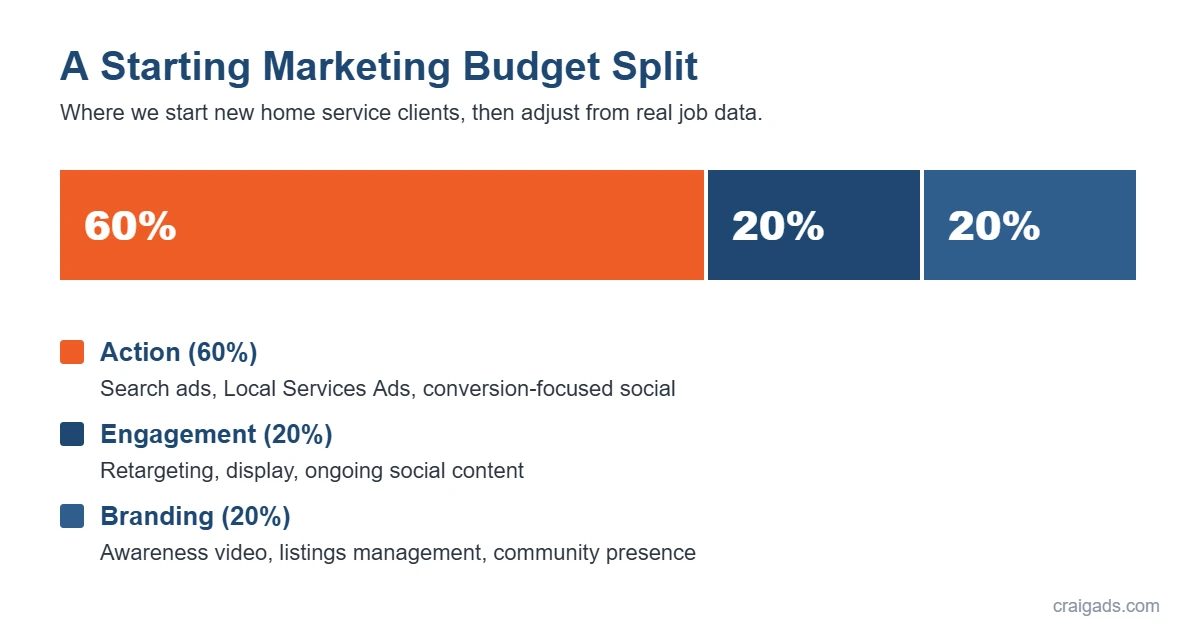
There is no universal number, because margins, average ticket size and competition vary by trade and market. Here is the starting split we use with new clients, adjusted from real job data after the first few months.
- About 60% to Action: search ads, Local Services Ads and conversion-focused social campaigns.
- About 20% to Engagement: retargeting, display and ongoing social content.
- About 20% to Branding: awareness video, listings management and community presence.
If one channel produces most of your paid jobs at a healthy cost, shift more of the marketing budget there. Keep spending steady for at least a few months, since ad platforms optimize better with consistent budgets. For benchmarks by business size and trade, read how much a home service business should spend on marketing. Planning next year already? Our 2027 local business marketing budget post covers timing and benchmarks.
A 90-Day Home Service Marketing Plan
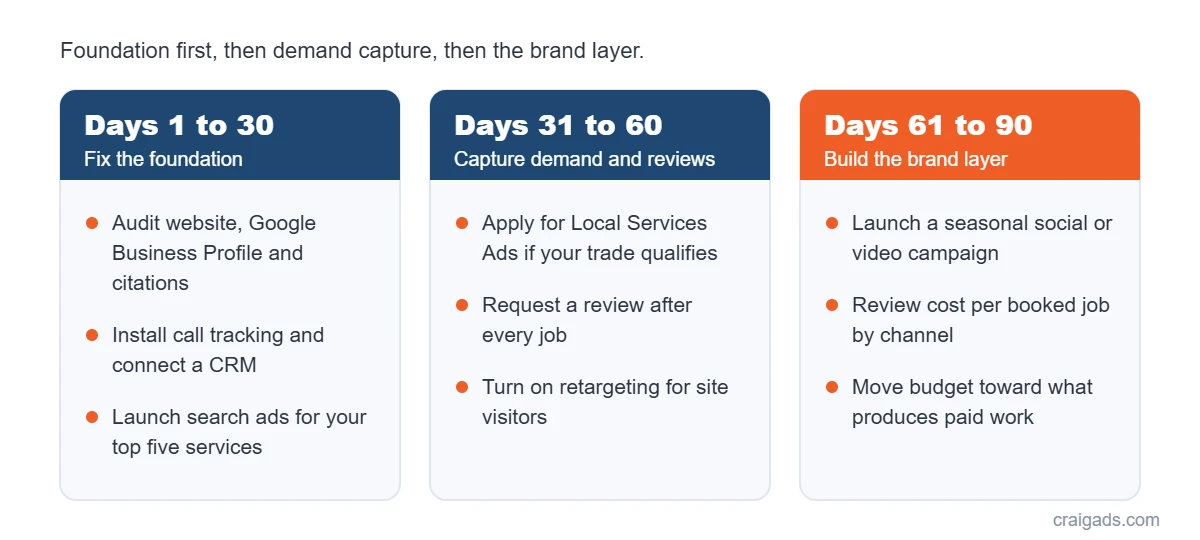
Foundation comes first, because ads and reviews perform better on a profile and website that are already in good shape.
Days 1 to 30: Fix the Foundation
Audit your website, Google Business Profile and directory listings. Install call tracking and connect your CRM. Then launch search ads for your top five services in your core towns.
Days 31 to 60: Capture Demand and Reviews
Apply for Local Services Ads if your trade qualifies. Start sending a review request after every completed job. Turn on retargeting for everyone who visits your website.
Days 61 to 90: Build the Brand Layer
Launch a seasonal social or video campaign aimed at homeowners in your best ZIP codes. Review the first two months of cost per booked job by channel. Then move budget toward the channels producing paid work.
After day 90, your home service marketing plan becomes a monthly rhythm: review the numbers, adjust the budget and refresh the creative. That rhythm is why every CraigAds client gets a monthly strategy call with their account manager. We explain the reasoning in why monthly strategy meetings are the key to marketing success.
Your Home Service Marketing Checklist
- Google Business Profile complete, with accurate categories, services and current photos
- One optimized page for each core service on your website
- Search ads live, with call tracking and location targeting
- Local Services Ads active, if they are available for your trade
- A review request sent after every completed job
- A retargeting audience built from website visitors
- A CRM connected to every lead source
- A monthly review of cost per booked job by channel
Build a Home Service Marketing System With CraigAds
CraigAds is a digital marketing agency in Carrollton, Georgia, working with home service companies across the country. We build the full funnel, track it to paid jobs and review the results with you every month. Schedule a free consultation to talk through your plan.

Craig McIlvain
Craig McIlvain is the owner of CraigAds, a collaborative digital marketing agency in Carrollton, Georgia that helps local businesses, franchises, and home-service companies get found and get chosen. With a master’s in applied psychology from USC and more than 2,000 local businesses served, Craig built his approach around one idea: people don’t decide based on information — they decide based on how something makes them feel. He works alongside clients rather than hiding behind dashboards, and he writes about local advertising, SEO, and the real reason customers pick one business over another. At home, he plays guitar and makes electronic music — and gets outvoted by his wife Julia and their kids on which Disney movie they’re watching next.