

Marketing rarely fails all at once. It drifts. A campaign that worked in spring keeps running in fall, a budget nobody has checked in months keeps spending, and a new competitor takes the top of the map without anyone noticing. Monthly strategy meetings are how you catch that drift while it is still cheap to fix.
Every CraigAds client gets a monthly strategy call with Craig, by phone or video. This post shares how we structure those meetings: the agenda, what each side brings, the numbers we review and the signs a meeting is not pulling its weight. You can use the same format with any agency or in-house team. For the channels themselves, see our complete guide to home service marketing.
In this post
- Why Monthly Strategy Meetings Matter
- A 6-Part Agenda for Monthly Strategy Meetings
- What to Bring to the Meeting
- The 5 Numbers to Review Every Month
- Signs Your Strategy Meetings Are Not Working
Why Monthly Strategy Meetings Matter
Home service demand moves with the weather, the season and the local economy. A quarterly review is too slow to react to a heat wave or a slow spring. A weekly meeting is usually too fast to show real trends, since one good week can hide a bad month. Monthly is the rhythm where results are big enough to read and changes are still small enough to make quickly.
The meeting also keeps marketing tied to the business. Your agency cannot know that you hired a new technician, raised prices or stopped offering a service unless you tell them. Ten minutes of that context often changes more than any campaign tweak.
Monthly strategy meetings also build a record. After six months, you can see which changes moved the numbers and which did not, which makes next year’s plan far easier to write. That history is hard to rebuild from memory.
A 6-Part Agenda for Monthly Strategy Meetings
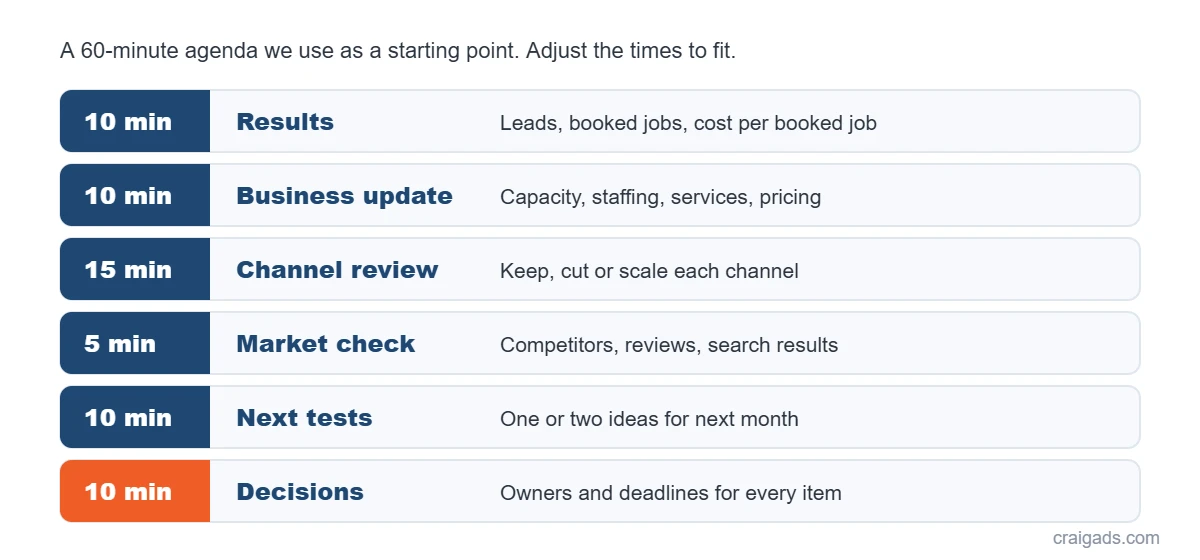
We keep the agenda the same every month, so nothing important gets skipped. The times below fit a 60-minute call.
1. Results: What Happened Last Month
Start with outcomes, not activity. How many leads came in, how many booked and what each booked job cost by channel? Compare against the prior month, and against the same month last year if you have the data.
2. Business Update: What Changed on Your Side
Cover capacity, staffing, new services, pricing and anything customers mentioned on calls. If the schedule is full for three weeks, more leads are not the goal right now.
3. Channel Review: Keep, Cut or Scale
Go through each channel with one question: keep it, cut it or scale it? Google Ads, Local Services Ads, SEO, social and retargeting each get a short verdict based on cost per booked job, not clicks. If paid and organic are competing for budget, our Google Ads vs SEO post explains how we weigh them.
4. Market Check: What Competitors Are Doing
Look at the search results and map listings in your main towns. Who moved up, and who is collecting reviews faster? Our free local search results checker shows what customers see from any town, which makes this a five-minute task.
5. Next Tests: One or Two Ideas
Pick one or two tests for the coming month, such as a new landing page, a seasonal offer or a new service area. More than two at once makes it hard to tell what actually worked.
6. Decisions: Owners and Deadlines
End with a short list of decisions, each with an owner and a date. A meeting without decisions is just a status update, and a status update could have been an email.
What to Bring to the Meeting
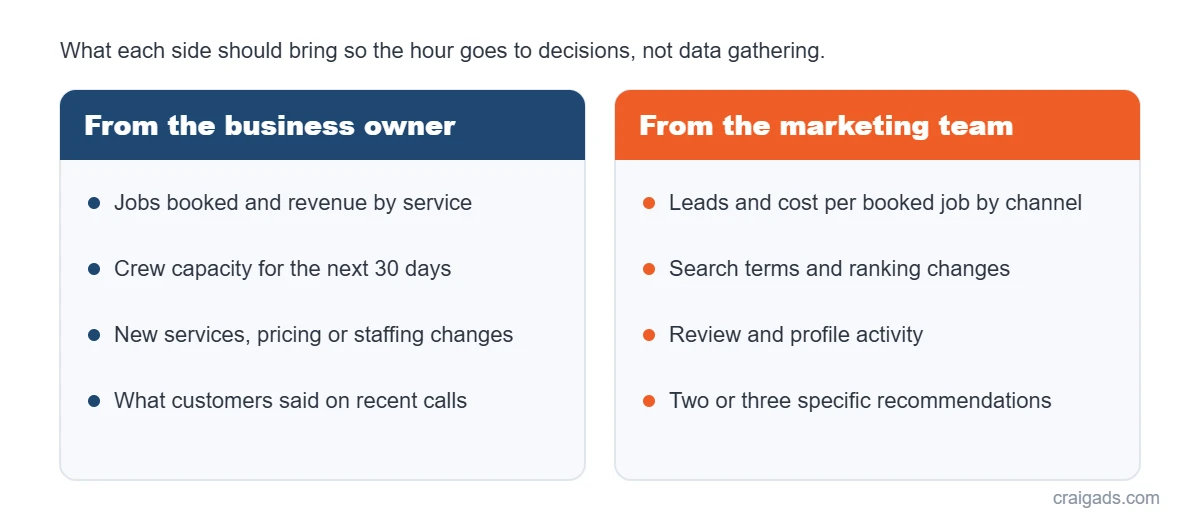
Productive monthly strategy meetings spend the hour deciding, not hunting for numbers. Both sides should arrive with their data ready.
Owners bring the business side: jobs booked, revenue by service and crew capacity. The marketing team brings the channel side, including search data. The Search Console Performance report shows which searches bring visitors to your website. The Google Ads search terms report shows the exact phrases behind ad clicks. Both often reveal services or towns that deserve more attention. Sharing both sets of numbers a day before monthly strategy meetings gives everyone time to spot questions.
The 5 Numbers to Review Every Month
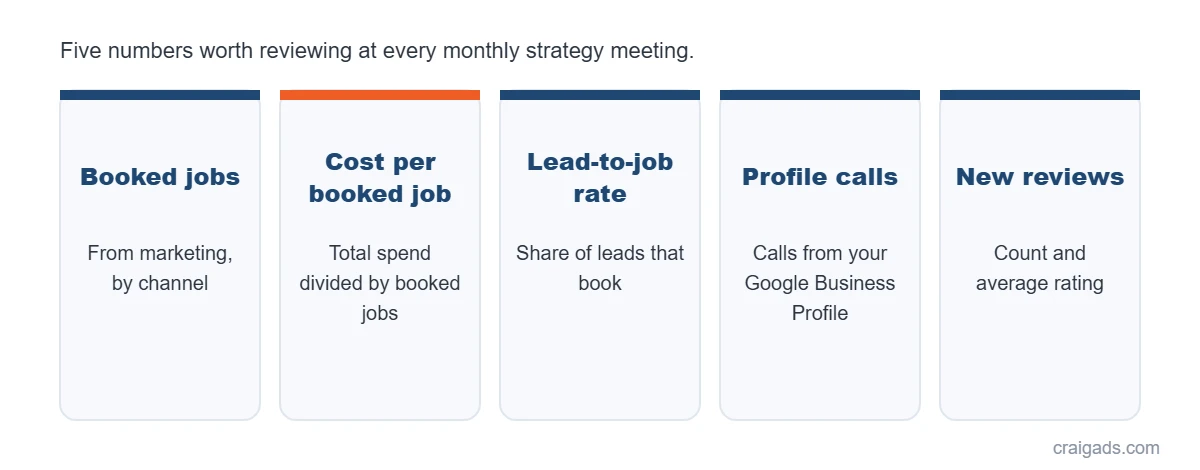
- Booked jobs from marketing: split by channel, so you can see where work actually comes from.
- Cost per booked job: total spend divided by booked jobs, the number that ties everything together.
- Lead-to-job rate: the share of leads that book, which shows whether the problem is lead quality or follow-up.
- Calls from your Google Business Profile: an early signal of map visibility.
- New reviews: the count and average rating added during the month.
If you are not sure how to calculate cost per booked job or plan spending around it, our post on building a home service marketing budget walks through the math.
Signs Your Strategy Meetings Are Not Working
- The meeting is a slide deck of clicks and impressions, with no booked jobs.
- The same problems come up month after month with no owner.
- Nobody asks about your capacity, pricing or crews.
- Recommendations stay vague, like “keep optimizing.”
- You leave without knowing what will change before next month.
If several of these sound familiar, the format of your monthly strategy meetings needs to change, not how often they happen.
Talk Strategy With Us Every Month
Every CraigAds client gets a monthly strategy call with their account manager, with Craig close to every account, to review results and make decisions together. Schedule a free consultation to see how it would work for your business.

Craig McIlvain
Craig McIlvain is the owner of CraigAds, a collaborative digital marketing agency in Carrollton, Georgia that helps local businesses, franchises, and home-service companies get found and get chosen. With a master’s in applied psychology from USC and more than 2,000 local businesses served, Craig built his approach around one idea: people don’t decide based on information — they decide based on how something makes them feel. He works alongside clients rather than hiding behind dashboards, and he writes about local advertising, SEO, and the real reason customers pick one business over another. At home, he plays guitar and makes electronic music — and gets outvoted by his wife Julia and their kids on which Disney movie they’re watching next.