

How much should a home service business spend on marketing? Percent-of-revenue rules give you a starting range, and our 2027 local business marketing budget post covers those benchmarks. A percentage cannot tell you whether the money will produce enough jobs to keep your trucks busy, though. A home service marketing budget works better when you build it from the bottom up, starting with the jobs you need and working back to the dollars it takes to win them.
This post walks through that method in five steps with a worked example. It then covers seasonality, what belongs in the budget and when to raise or cut spending.
In this post
- How to Build a Home Service Marketing Budget in 5 Steps
- A Worked Example
- Adjust Your Home Service Marketing Budget for Seasonality
- What Belongs in a Home Service Marketing Budget
- When to Raise or Cut Spending
- Budget Mistakes to Avoid
How to Build a Home Service Marketing Budget in 5 Steps
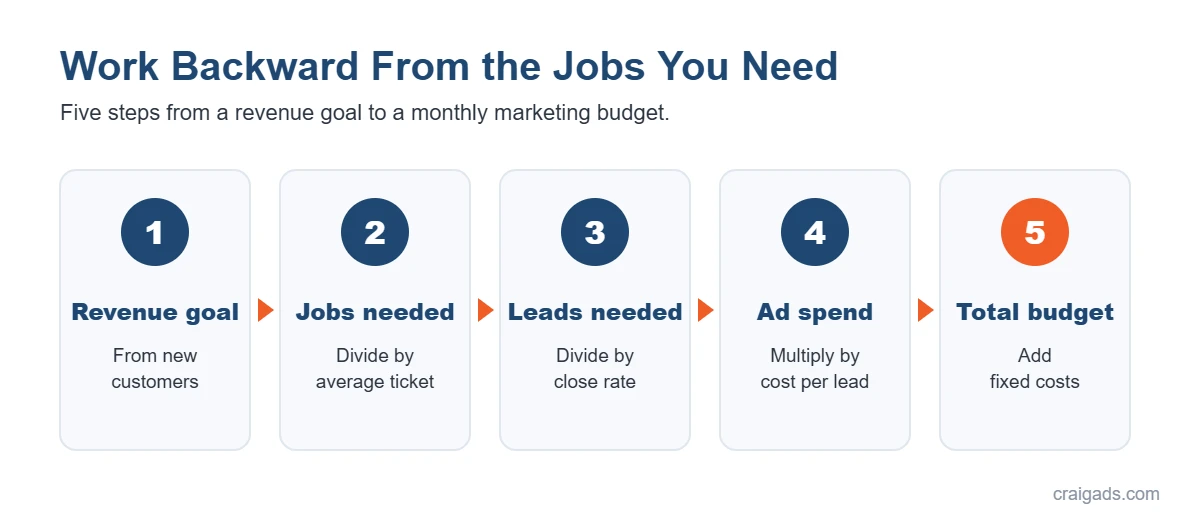
Step 1: Set a Revenue Goal From New Customers
Start with the revenue you need from new customers, not total revenue. Repeat customers, maintenance agreements and referrals already arrive without ad spend. Marketing has to fill the gap between what those bring in and where you want to be.
Step 2: Divide by Your Average Ticket
Divide that revenue goal by your average ticket for new customers. A $40,000 monthly goal at a $400 average ticket means 100 new jobs a month. If you sell very different services, such as repairs and full replacements, run this step separately for each.
Step 3: Divide by Your Close Rate
Not every call books. Pull this number from your CRM or call log by dividing booked jobs by qualified leads. If you close half your leads, 100 jobs requires 200 leads. Raising your close rate is often the cheapest way to shrink the budget.
Step 4: Multiply by Your Cost per Lead
Use your own cost per lead by channel if you track it. If you do not, run a test month on search ads and Local Services Ads to get a real number instead of an industry average. Local Services Ads charge per lead, and Google credits many low-quality leads automatically, which makes that cost easier to read. Multiply leads needed by cost per lead to get your monthly ad spend.
Step 5: Add Your Fixed Costs
Ad spend is only part of a home service marketing budget. Add the costs that do not change with lead volume: SEO and content, agency management, call tracking, CRM software, photography and review tools. These tend to stay flat from month to month.
A Worked Example
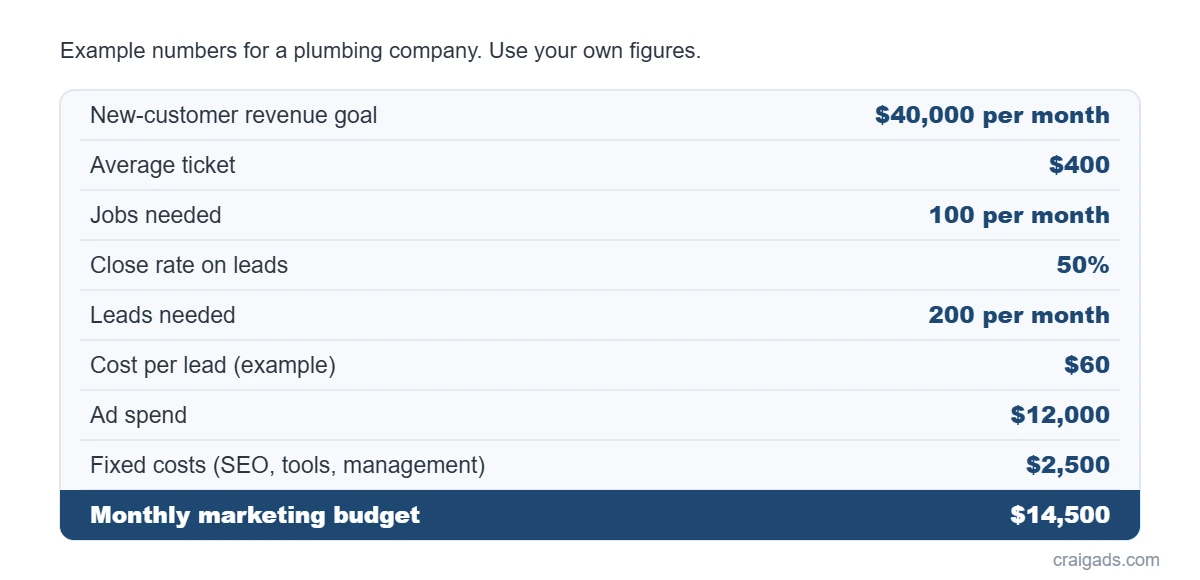
Here is how a home service marketing budget comes together, using example numbers for a plumbing company. They are illustrations, not benchmarks, so swap in your own figures. The company wants $40,000 a month from new customers at a $400 average ticket, so it needs 100 jobs. It closes 50% of its leads, so it needs 200 leads. At an example cost of $60 per lead, ad spend comes to $12,000. Fixed costs of $2,500 bring the total to $14,500 a month.
Next, compare that number to the revenue it is meant to produce. Here the budget is about 36% of new-customer revenue. That is high for one-off repairs, but it can make sense when new customers stay for years. If the number looks too high, the levers are the same five: a bigger ticket, a better close rate, a cheaper lead mix, a smaller goal or a longer timeline.
Adjust Your Home Service Marketing Budget for Seasonality
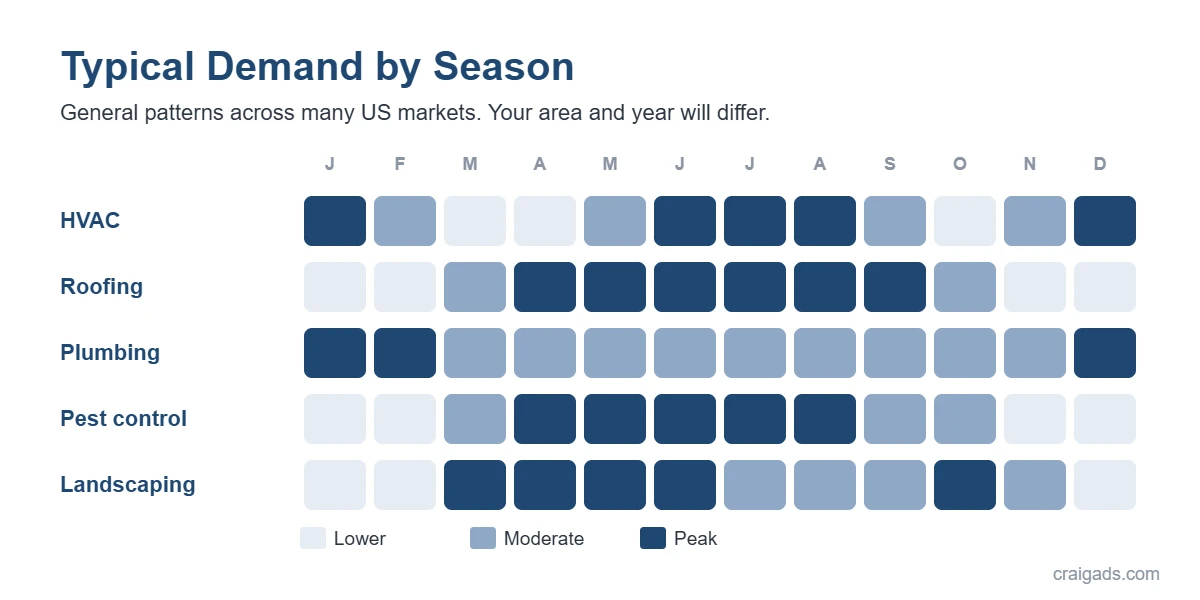
Most trades have busy and slow months, and a flat budget wastes money in one while starving the other. Raise ad spend ahead of your peak, not after it starts, since new campaigns need time to settle. Google Ads lets you change your average daily budget at any time, which makes seasonal shifts simple. In slow months, keep brand and SEO work steady instead of going dark, so you stay visible when demand returns.
What Belongs in a Home Service Marketing Budget
- Ad spend: search ads, Local Services Ads, social campaigns and retargeting.
- Management: agency fees or the in-house hours spent running campaigns.
- SEO and content: service pages, website updates and blog posts.
- Tools: call tracking, CRM software and review request systems.
- Creative: job photos, video and ad design.
Leaving any of these out makes the budget look smaller than it is and hides the true cost of each job. For how to split ad spend across channels, see our complete guide to home service marketing. If you are deciding between paid and organic, read Google Ads vs SEO for home service companies.
When to Raise or Cut Spending
Raise your home service marketing budget when cost per booked job is stable or falling and your crews have open capacity. Hold it steady when the schedule is full, because buying leads you cannot serve wastes money and can hurt reviews. When one source keeps producing leads that do not book, cut that channel rather than the whole budget. Review these numbers every month. That is the purpose of the monthly strategy meeting every CraigAds client has with their account manager.
Budget Mistakes to Avoid
- Judging channels by cost per click instead of cost per booked job.
- Going dark in the slow season, then paying more to restart in the busy one.
- Spreading a small budget across too many channels to learn anything.
- Leaving fixed costs out, which hides the true cost of each job.
- Copying a competitor’s spend without knowing their ticket size or close rate.
Let’s Build Your Budget From the Jobs You Need
Bring us your revenue goal, average ticket and close rate. We will help you turn them into a home service marketing budget, with each dollar assigned to a channel you can measure. Schedule a free consultation to get started.

Craig McIlvain
Craig McIlvain is the owner of CraigAds, a collaborative digital marketing agency in Carrollton, Georgia that helps local businesses, franchises, and home-service companies get found and get chosen. With a master’s in applied psychology from USC and more than 2,000 local businesses served, Craig built his approach around one idea: people don’t decide based on information — they decide based on how something makes them feel. He works alongside clients rather than hiding behind dashboards, and he writes about local advertising, SEO, and the real reason customers pick one business over another. At home, he plays guitar and makes electronic music — and gets outvoted by his wife Julia and their kids on which Disney movie they’re watching next.