

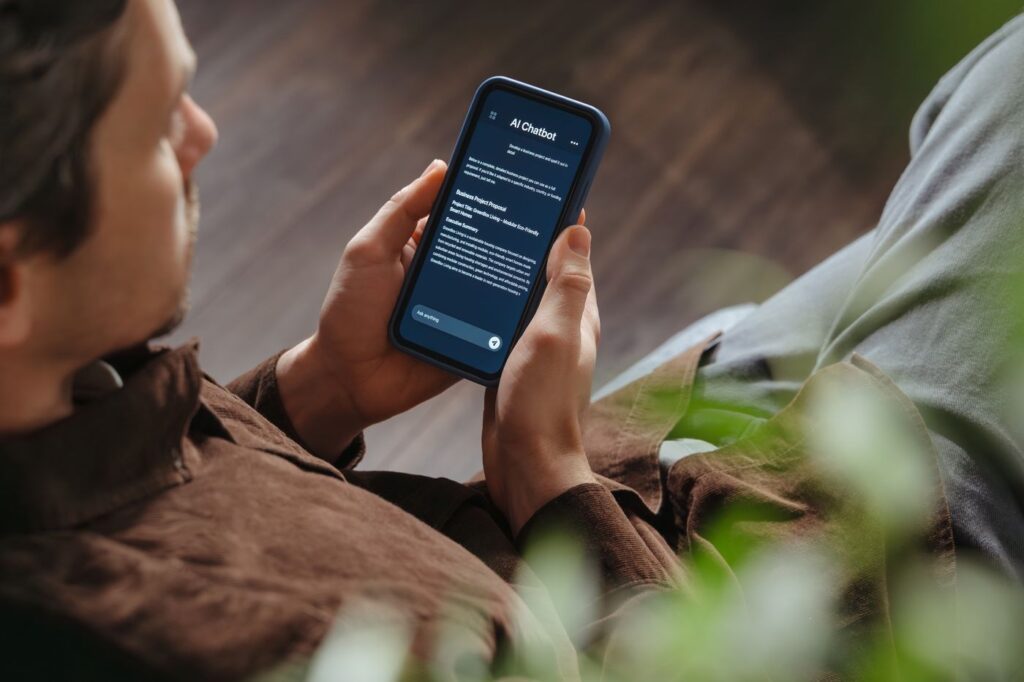
Google for the find, AI for the task — what 62 West Georgia residents reveal about the changing local search journey, and why urgency, intent, and industry shape where consumers begin.
Consumers are not choosing one search tool. They use AI to think through the need and Google to verify, find, and contact a local business.
completed surveys, 17+ hours in the field
local-search answers collected
used AI daily or weekly
preferred mobile search
of direct business choices favored Google
of all 5,828 answers went to Google
Before you read this study: Craig's take
Let me tell you why this study exists, because it reveals my agenda, and I'm fine with that.
I run an SEO agency. My clients ask me the same question almost every week: how much should I focus on Google, and how much should I focus on AI? For a long time the industry answered that question with opinions. I wanted to answer it with data. So we went out and got some — 62 people, face to face, right here in West Georgia. Not because face-to-face is some methodological ideal, but because it was practical. Ironically, local folks are more likely to take a survey standing in front of you than sitting at a computer. So that's what we did.
You're about to read what we found. Before you do, I want to teach you how to read it — because the numbers will tempt you toward two opposite mistakes, and I've watched business owners make both.
Mistake one is thinking AI has already taken over. It hasn't. Look at the daily AI users in this study — the power users, the people who touch AI every single day. Even they still gave Google the bigger share of their local decisions. Sit with that. The people most immersed in AI still turn to Google when it's time to find a local business. Google is still number one, and it's not close.
Mistake two is thinking that means nothing is changing. Going into this, I honestly expected Google to be even more dominant than it turned out to be. The decline is definitive. Both things are true at once — Google is winning, and Google is shrinking — and that combination is exactly what leaves business owners paralyzed. My job in this commentary is to un-paralyze you.
Here's the framework I want you to carry through the whole study. Google is now also AI — that's what its June update was about, stitching AI into search so it feels seamless. But notice the ordering. Google is search first, then AI. Every AI engine is AI first, then search. When ChatGPT or Claude needs a local business, it goes and runs a search and pulls in local results anyway.
So the real question isn't Google versus AI. It's which door people walk through first. And my bet — I'll say it plainly — is that AI-first will eventually win in the future, because it's simply more convenient to say "help me solve this" and let something else do the searching. But "eventually" is doing a lot of work in that sentence, and the data in this study tells you what to do today.
For today, though, the data is clear, so let me say it plainly: Google is still number one. Focus primarily on what Google has to say about SEO for today — and know that tomorrow could be a more AI-focused future.
Search now has more than one path
A homeowner with water spreading across the floor is likely to open Google, scan local plumbers, check availability and call. A person comparing skincare products or hair services has more time to describe preferences, ask follow-up questions, and refine the answer through AI.
That contrast is a useful example, not the whole story. The CraigAds West Georgia AI Search Habits Survey found a broader two-tool habit: urgency and local action still push consumers toward Google, while advice, personalization, and deliberation create more room for AI. The shift is not unique to West Georgia: a national study reported by Search Engine Land found that 37% of consumers now start some searches with AI instead of Google.
AI vs. Google: what the study measured
The survey collected 62 completed responses over approximately 17 hours across three days in July 2026. Participants were recruited in downtown Carrollton, near the University of West Georgia and at nearby businesses. Each completed a roughly 10-minute questionnaire and received a $5 cash incentive.
The questionnaire measured AI frequency, device use, trust, and task preferences. It also presented 47 problem-shaped situations and the same 47 needs as direct business categories. Together, those grids produced 5,828 local-search answers.
This was a convenience sample, not a population estimate. Half of respondents were ages 20–24, no participant was 65 or older, and the long grid encouraged some respondents to repeat the same answer. The precise category percentages should therefore be read directionally; the strongest value is in the repeated patterns.
Figure 2. Source: CraigAds West Georgia AI Search Habits Survey, 2026. Percentages may not total 100 because of rounding.
AI is already routine for many respondents
Fifty-three respondents (85.5%) reported at least some AI use. Thirty-seven (59.7%) used it daily or a few times a week, while nine did not use AI at all. AI was no longer described as a novelty; participants discussed it as part of school, work, organization, planning and creative tasks. That tracks the national picture: Pew Research Center's Americans and AI 2026 study found that about half of U.S. adults now use AI chatbots, with roughly a quarter using them daily.
Figure 3. Thirty-seven of 62 respondents used AI daily or a few times a week.
Habit matters more than simple familiarity
Daily users behaved differently from everyone else. Among the 14 daily AI users, 33.2% of local decisions went to AI, and 47.0% went to Google. Among weekly, occasional, and non-users combined, only 5.9% went to AI while 72.2% went to Google. The practical dividing line was not whether someone had tried AI; it was whether AI had become a daily habit.
Figure 4. Shares combine all 47 scenarios and 47 business categories.
Most people are building a two-tool habit
For quick answers, 28 respondents selected both Google and AI, 27 selected Google and only seven selected AI alone. That near tie between combined use and Google-only use is one of the clearest signs of change. AI influence is larger than the AI-only category suggests because many people added it without abandoning Google. National data points the same direction: Gartner's January 2026 consumer survey found only about one-third of consumers say generative AI rivals search engines — and advised marketers to optimize for both AI-driven and traditional search.
Figure 5. Mixed Google-and-AI use was almost as common as Google-only use for quick answers.
Google and AI are being assigned different jobs
The task results show why the two tools coexist. Google led for general questions, research, comparing products or services, health and wellness questions and local business recommendations. AI led for writing or editing and creative ideas. Work-related tasks were tied, and trip planning was close.
Participants repeatedly described Google as the place for business hours, phone numbers, directions, quick facts and local options. AI was the place for explanations, drafts, comparisons, brainstorming and personalized guidance. The reasons respondents chose AI fit that role. They valued faster answers, more detail, follow-up questions, personalization and less scrolling. The appeal is not only the answer, it is the ability to keep the conversation moving.
The simple version: "find it" versus "help me do it."
The wording of the need changes the answer
The survey asked the same local decision in two ways. First, it described a situation, such as a leaking roof or a garage floor upgrade. Then it asked about the direct business category, such as a roofing company or garage floor coating company.
Across the problem-shaped questions, 58.1% of answers favored Google, 14.4% favored AI, and 27.5% were a toss-up or neither. When the wording shifted to a business category, Google rose to 74.9% while AI fell to 9.8%.
A consumer may ask AI why an appliance failed, what questions to ask a roofer, or which coating system is best. But when the prompt becomes "find a company," Google, Maps, reviews, and direct contact information regain the advantage. AI is most visible earlier in the journey; Google remains the strongest bridge to local action.
Beauty and plumbing make the contrast easy to see
When respondents imagined needing hair, skincare or beauty services, 24.2% said AI could fully or somewhat help. For a clogged toilet, broken pipe or plumbing issue, only 6.5% selected AI. AI entered the beauty decision nearly four times as often as the plumbing emergency.
Beauty decisions are often personal, descriptive and open-ended. AI can remember the details, ask follow-up questions and compare options. Plumbing compresses the decision. A burst pipe creates immediate risk, a geographic limit and a need for someone who can answer the phone now. AI may explain how to shut off the water, but it does not replace the map, reviews, availability and click-to-call experience. Once the question became a direct provider search, 77.4% selected Google for both categories.
Figure 10. Deliberate or advisory needs drew more AI involvement than urgent, transactional problems. Rankings are directional because of sample size and repeated-answer effects.
Where garage floor coating fits
Garage floor coating sits in the deliberate middle. When the need was framed as an upgrade project, 17.7% selected AI, well above the plumbing emergency. When the wording became "garage floor coating company," AI fell to 9.7%, and Google rose to 74.2%. The implication is practical: detailed content can influence the research phase, while Google visibility remains critical when the homeowner is ready to compare companies and call.
Mobile is the common ground
Fifty-one respondents (82.3%) preferred searching on a mobile device. Whatever combination of Google and AI a customer uses, the journey usually lands on a small screen.
What local businesses should do
For home service businesses weighing AI vs Google, the data says the answer is both — weighted heavily toward Google today. In practice:
- Protect the Google foundation. Keep hours, phone numbers, categories, service areas, photos, reviews and links accurate.
- Answer the questions before the provider search. Publish clear pages about problems, options, costs, comparisons, timelines and next steps.
- Match the content to the decision. Considered services benefit from depth and personalization; emergency services should prioritize speed, location and availability.
- Use real proof. Local photos, recent reviews, credentials and specific examples help both people and systems evaluate the business.
- Measure the whole journey. A customer may begin in AI, verify in Google and convert from a map listing or phone call.
How we apply this
The AI Search Optimization page shows exactly how this study turns into work on a client's website and profile.
The bottom line
AI has not replaced Google in West Georgia local search. It has changed the route. Google remains the dominant discovery and action engine for local providers, while AI is becoming the conversational layer used to explain, compare, write, organize and decide what to do next.
For local businesses, the answer is not to choose one platform. It is to remain easy to find on Google and easy to understand wherever an AI system may summarize or compare the business. Accurate information, useful answers and real proof support both sides of the journey.
Limits and what to watch next
The findings are descriptive and local. The young age skew, in-person convenience sample, absence of respondents 65 and older, and repeated-answer effect limit generalization. The survey measured stated preferences rather than observed search sessions, so it cannot always show which platform came first.
A shorter annual survey could turn this study into a useful baseline. Future research should recruit more older adults and business owners, track the order in which people move between tools, and test whether the beauty-versus-plumbing gap persists as AI becomes more integrated into Google itself.
References
- CraigAds. (2026). West Georgia AI search habits survey [Unpublished data set]. Full appendix: 20 questions, all 62 responses, 47 scenarios and 47 business categories (carried over from the live post).
- Gartner. (2026a, January 20). Gartner survey finds only one-third of consumers say GenAI rivals search engines.
- Gartner. (2026b, May 27). Gartner survey finds consumers want AI shopping help, but not AI purchase decisions.
- Pew Research Center. (2025, July 22). Google users are less likely to click on links when an AI summary appears in the results.
- Pew Research Center. (2026, June 17). Americans and AI 2026: Chatbots, smart devices and views on impact.
- Search Engine Land. (2026, January 7). 37% of consumers start searches with AI instead of Google.