

Year one of a franchise brand is about proving the model and signing the first owners. Year two is when the cracks start to show. One location runs its own ads, another has two Google profiles, and a third has no idea which calls booked. Without franchise marketing systems in place, every new location adds a little more inconsistency.
We work with franchisors and their local owners, so this list comes from both sides of the table. These are the seven franchise marketing systems we think every brand should have by the end of year two. If you are a franchisee, our post on the franchise marketing mistakes owners make is the companion piece.
In this post
- Why Franchise Marketing Systems Matter in Year 2
- 7 Franchise Marketing Systems to Build
- Signs Your Brand Needs Better Franchise Marketing Systems
- A Sample Year 2 Rollout
Why Franchise Marketing Systems Matter in Year 2
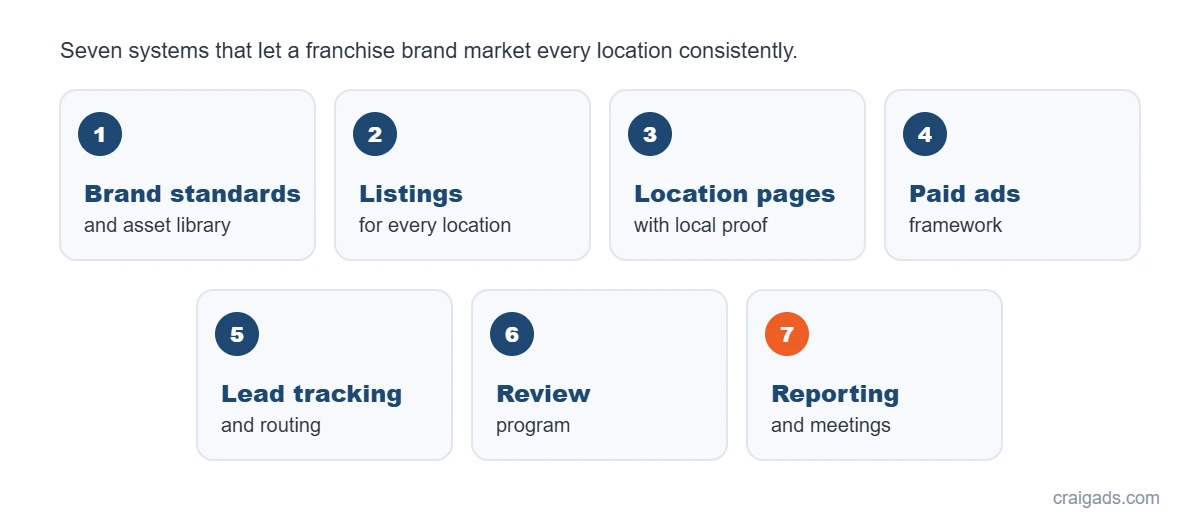
In the early days, a founder can personally review every ad and answer every question from a new owner. That stops working as the network grows. Franchise marketing systems replace that personal attention with tools, templates and rules that work without the founder in the room. They protect the brand, make it easier for owners to market well and give corporate a clear view of what is working.
7 Franchise Marketing Systems to Build
1. Brand Standards and an Asset Library
Every location needs the same logo files, colors, fonts, voice guidelines and approved photos. Put them in one shared library that owners can reach without emailing corporate. Add ready-to-use templates for the materials owners request most, such as social posts, flyers, yard signs and ads. The easier the approved version is to find, the less off-brand work you will see. Add a simple approval process for anything owners create themselves, with a clear turnaround time, so good local ideas do not stall.
2. Listings for Every Location
Each location needs one accurate Google Business Profile, plus consistent listings on Apple, Bing and the major directories. Google’s guidelines for representing your business include a section on chains and brands. Decide who owns each profile, who can edit it and how new locations get set up. Our post on whether a business should have multiple Google Business Profiles covers the edge cases.
3. Location Pages With Local Proof
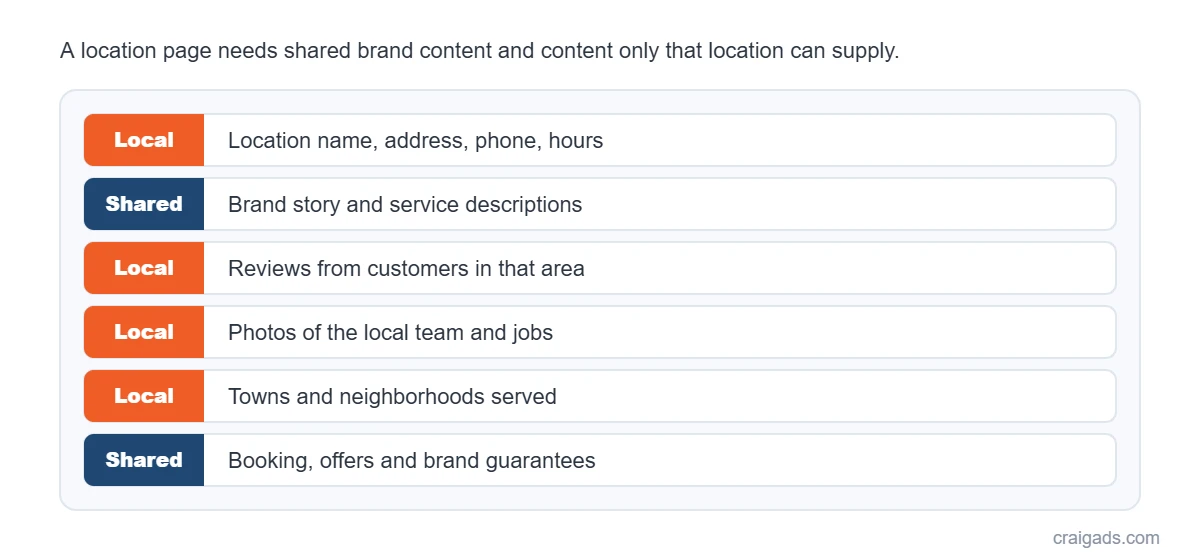
The brand website should have a page for each location, built from a shared template with room for local content. Shared blocks cover the brand story and services. Local blocks cover the address, team, reviews, photos and towns served. Pages that only swap the city name tend to go unindexed, which we see regularly in Search Console. Mark up each page with LocalBusiness structured data that matches its profile.
4. A Paid Ads Framework
Set rules for how locations advertise: account structure, which keywords belong to the brand, how territories are divided and the minimum budget that makes a campaign worth running. Clear territory rules stop owners from bidding against each other in the same towns. If the brand runs a co-op program, spell out how funds are matched and approved. Decide who bids on the brand name itself, too. When every location bids on it separately, the brand ends up competing with itself for its own customers.
5. Lead Tracking and Routing
Every lead should be tagged with its source and its location. Use call tracking numbers by location and channel, route web forms to the right owner and connect both to a CRM. That lets corporate compare locations fairly and lets owners see their own cost per booked job. Our CRM setup and marketing automation service can build this for a multi-location brand.
6. A Review Program
Reviews drive local visibility for every location, so they deserve a shared process. Give owners a same-day request flow, response guidelines and a way to escalate serious complaints. Keep the program within the FTC’s consumer reviews rule, which bars fake reviews and incentives tied to positive ratings.
7. Reporting and a Meeting Cadence
Build a simple dashboard for each location and a roll-up for the brand. Review it on a schedule: monthly with each owner or region, and quarterly across the network. Our post on monthly strategy meetings includes an agenda you can adapt.
Signs Your Brand Needs Better Franchise Marketing Systems
- Owners regularly ask corporate for logos, photos or ad copy.
- Locations show different names, hours or phone numbers across directories.
- Two or more units bid on the same towns in Google Ads.
- Corporate cannot say which locations produce the lowest cost per booked job.
- New owners take months to launch local marketing after opening.
If two or more of these sound familiar, start with the systems that address them directly.
A Sample Year 2 Rollout
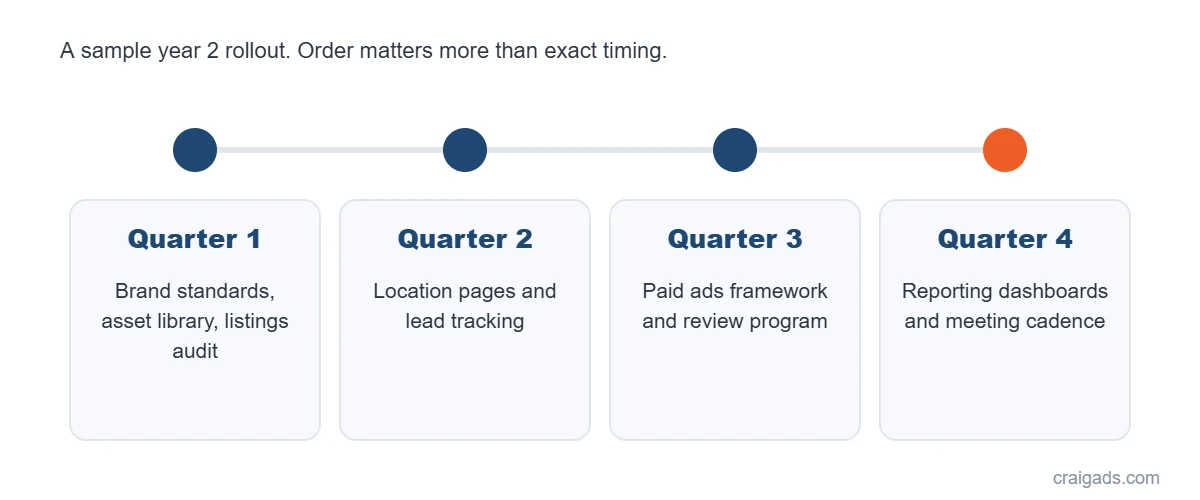
You do not need all seven franchise marketing systems at once. Start with brand standards and a listings audit, since every other system depends on them. Add location pages and tracking next, then ads and reviews, and finish with reporting. Each quarter should leave owners with fewer questions than the last.
Build Your Franchise Marketing Systems With CraigAds
We help franchisors build brand-compliant marketing frameworks that support every location. Learn more about our franchise digital marketing services, or schedule a free consultation to talk through your year 2 plan.

Craig McIlvain
Craig McIlvain is the owner of CraigAds, a collaborative digital marketing agency in Carrollton, Georgia that helps local businesses, franchises, and home-service companies get found and get chosen. With a master’s in applied psychology from USC and more than 2,000 local businesses served, Craig built his approach around one idea: people don’t decide based on information — they decide based on how something makes them feel. He works alongside clients rather than hiding behind dashboards, and he writes about local advertising, SEO, and the real reason customers pick one business over another. At home, he plays guitar and makes electronic music — and gets outvoted by his wife Julia and their kids on which Disney movie they’re watching next.